|
As COVID-era plans develop for back to school time, there are multiple areas of focus: safety, skill development, social-emotional health and the creation of a positive “new normal” for operating schools in 2020 and beyond. It is good to see that the “Fourth R” - resilience - is getting a fair share of attention as well.
Schools and districts are working hard to manage physical health risks and to create strong and supportive social-emotional foundations. Such a framework has to be flexible enough to meet the needs of the full range of learners. What may be a moderate challenge for one child can be overwhelming for another, so re-calibrating expectations is essential. One size won’t fit all. It never did. For kids who struggled in pre-COVID times, there are even more formidable challenges now. Youngsters who have experienced increased incidents of stress, anxiety and trauma will sometimes face challenges that exceed their capacity to function effectively. Every time resources and strategies strengthen a child’s resilience - through guidance and support, empathy and encouragement – the outcome will be more successful than “try harder” admonitions or punitive sanctions. What is that Fourth R about? Resilience is the capacity to deal with significant stressors and then be able to reflect, recover, refocus and re-energize. It essential for individuals, families, communities and systems. We aren’t born infused with a lifetime supply of resilience; it develops over time through nurturing relationships, lived experiences and strategies we are taught that shape our development. At times like this, when the environment around us is substantially disrupted, our resilience can be tested, along with our capacity to self-regulate and function productively. We see the results all around us. Adults who become unruly and refuse to follow basic guidelines at a grocery store or restaurant are dysregulated: they are processing too many stressors and have too little capacity to cope and refocus. A pandemic can do that. Children facing an unfamiliar learning landscape when they return to school may not have the reservoir of experience and energy to successfully navigate novel and uncomfortable experiences. Many kids will need additional time, space and a co-regulating adult to build up the resilience needed for them to be successful the next time... or the time after that. It is interesting to scan the “restart” education resources across Canada and beyond. There is a universal focus on the primacy of social-emotional health and a growing recognition that overwhelmed kids can’t learn. Youngsters’ ability to engage in the “3 Rs” and other core competencies, doesn’t happen without attention to social-emotional health including the 4th R - Resilience - as a foundation. Bottom line? We create a better new normal when it is infused with attention to social-emotional health and resilience. Following are links to several resources that may be helpful on this journey, both for professional reflection and for sharing with parents: https://www.healthlinkbc.ca/health-topics/abk9962 This short article from HealthLinkBC identifies specific resilience-focused strategies. In our new normal, we will need them. https://childmind.org/article/how-to-help-kids-deal-with-rejection/ From the Child Mind Institute, these 5 tips focus dealing with rejection and disappointment with simple explanations as to what responses will benefit a child. https://childmind.org/nixieandnimbo/ Another Child Mind Institute resource. This animated series of short clips is for young children as they tackle concepts such as anxiety and begin to learn coping strategies. Links for parents and caregivers are also available. cators and caregivers. Great tips and reminders. https://www.naeyc.org/resources/pubs/yc/jul2020/preventing-compassion-fatigue This article explains how the body responds to stress, and offers suggestions on how to recognize and manage the compounding impact of stress on the care giver. It’s a good reminder that self-care by adults is essential if we are to provide the effective support youngsters require. The article is aimed at early childhood educators, but the messages and strategies will resonate for educators throughout the system. It can be frustrating to continually see the gap between what we know and what we do. There are so many examples where knowledge gained through research, lived experience, expert advice, successes and failures… is bypassed in favour of comfortable routines, hollowed out ideologies or fear of unfamiliar territory. And then…along comes a global pandemic, changing everything. To what extent will current adaptations endure beyond the short term? Will new routines at home, in our communities, workplaces and our education space actually alter the “set point” for normal, or will our efforts and energies be dedicated to going forward by going back? In education, it will be fascinating to see how the pandemic-initiated teaching/learning culture does or doesn’t influence the long-term structure and rhythm of a place called school. Our journey through weeks of unsettling change, high speed innovation and adaptation creates much potential for real educational transformation, including in these three areas:
Shining a brighter light on Social-Emotional Learning (SEL) and health: We know that SEL is essential to positive teaching/learning dynamics and the social value of the school system. That’s not new. However, in many places, the focus on SEL has long been relegated to background status: important to pay attention to, but not on par with the effort or the metricsassociated with academic achievement. This second-tier status has occurred even when we know that social/emotional health is a foundation for academic and other successes. How quickly things change. During these anxious times, the richest conversations about education highlight the importance of mental health and how the school system must do its best to connect with children and families at a distance, and how to prepare for a return to class that will have its own unique emotional dynamics. Beyond the current circumstances, once the school house is up and running again, SEL must rightly take its place alongside the other indicators of effective learning organizations. It’s a priority and requires resourcing and capacity building via proactive and responsive SEL initiatives. For those school communities already rich in an SEL culture, there is an opportunity to build on strong foundations. For others, the current focus is a reminder of what’s essential for learning to take hold and for kids to thrive; The whole staff as a collaborative team: As we “simultaneously build the plane and fly it” in reshaping teaching and learning, it is important to acknowledge and access the skills and resourcesof the entire staff team. Teachers and administrators are clearly key players in the learning dynamic, and there is a growing recognition of the value of other team members as we navigate new realities. The Education Assistant who connects by phone or on line to offer guidance to a student is the school for that student and family in that moment. The support staffer providing on site care for essential service workers’ kids is the exemplar of a responsive, compassionate and flexible school system that can serve its communities beyond the bells…and the list goes on. All of these professionals are key members of the team, working in tandem with teachers to connect with families, build trust, sooth concerns and navigate learning challenges. They help make school a human place, both on site and at a distance. It’s a reminder that the sacred trust “Every Child/Every Chance/Every Day” is made possible when all staff members do what it takes to support each of the youngsters for whom they share responsibility. Going forward, let’s hope that support staff are fully valued and appreciated as essential team members, helping to make the differences all kids need; Will “blended learning” go mainstream in our high schools?: Even with all the talk, effort and action around the transformation agenda, there has been reluctance in many places to break away from 5X8 timetables and organizational models grounded in kids in seats at pre-arranged times. The COVID-initiated suspension of in-class learning has fast-tracked everyone into alternative ways to activate learning, demonstrateengagement and achieve mastery. Will these innovations last beyond the current crisis or will next year’s courses be delivered in familiar ways? School, as a real time/real place learning environment should continue to be essential for all kinds of academic, social, emotional and practical reasons. We are social creatures and the school community is crucial to countless dimensions of learning and growing. So, school being “in” should always be important, but we also have a rare opportunity to explore and experience environments where time, space, interests and abilities are flexed to engage and personalize the learning journey. Do high schools require the full student and staff population on site at the same time, Monday through Friday? What would it look like for a course like Social Studies 11 (just an example) to be organized to include: attendance at several required seminars and breakouts; engagement in virtual synchronous and asynchronous learning moderated by the teacher; individual tasks and assignments completed on line; and on-site and remote connections/tutorials and support sessions with course teacher for coaching and feedback? Possible? Yes. Status Quo? Not even close. Likely? We will see. Transformational opportunities show up in unusual ways and at unpredictable times. Whether we use them to transform to a preferred future or just survive the present crisis remains to be seen. Whither Truth…or…Wither Truth
Whither def: to what place or state Wither def: (to cause) to become weak and dry and decay In an era renowned for fake news, alternative truths and echo chambers, we have to be concerned about the state and perceived value of truth, especially given that our social structures were built on the virtues of truth, honesty and integrity as foundations. For them to remain essential (they must), let’s consider the role of our schools can play to undo the erosion we see all around us. For educators, that is no small challenge. Along with engaging in a Transformation Agenda and a renewed curriculum based on Big Ideas, we need to guide young learners to navigate 21 century complexities through lenses of curiosity and deep exploration rather than through a “post-truth” narrative so evident politics, business and relationships. We know that young learners deserve better than to be captured by a social-media environment that promotes diatribe over dialogue and excuses over responsibility. The role of the school is essential in helping learners break away from echo chambers that sensationalize, polarize and marginalize. Our kids are ready to embrace the challenge. We see that every day as their perspectives grow and their voices and social conscience become stronger. To create a classroom environment where we can thoughtfully explore complex truths, schools can’t insulate themselves and isolate students from the pre-packaged (no thought required) 24/7 digital content driven by our search engines. Such content is easily digestible, but it isn’t healthy or nourishing. School has to be a place where complex issues are illuminated and values-rich discussions are the norm. For that to happen responsibly, schools are developing ways, right now, for kids to consider a range of perspectives and separate facts from opinions so they can engage in intelligent dialogue rather than be swayed by the bullying rancour that dominates our bandwidth. Every learner needs to be able to engage in thoughtful and deep discourse around difficult topics. S/he needs to skilfully navigate sensitive and polarizing issues, with the support of teachers who are able to establish and maintain respectful environment. For “tomorrow’s leaders…” to have the capacities to take on that role, it is essential that they have scaffolded experiences exploring and unpacking complex, awkward and sensitive social, environmental, political and other issues long before they walk across the stage and receive their diploma. If we fail at that, it is at our peril. It’s not a simple task and it calls for a radical shift from the safe and controversy-averse stance that communities have traditionally expected their schools to adopt. In a simpler time, curriculum guidelines and requirements were focused on transmitting facts and processes - knowledge content - from the learned to the learner. Teachers’ primary role was to instruct, starting with basic skills and progressing into more complex applications and variations of those skills. Educators were cautioned about bringing controversial, polarizing subjects into the classroom. The teacher in a lumber industry town might have been wise to shy away from exploring a range of perspectives related to environmentalism and protection of natural forests. The classroom in a town where there have been racial tensions may have avoided topics associated with race relations rather than risk inflaming parent and community pushback. Similar sensitivities would be in place for topics like oil pipelines among others. However, that was then, this is now. Cocooning our children, particularly as they develop awareness and analytical skills through the intermediate and high school years isn’t responsible. We don’t provide our students good service if we isolate and insulate them from multi-dimensional issues when they are already being relentlessly exposed to such matters in an unfiltered and un-moderated way through their social media and other channels. Timid, issue-avoidant classroom themes won’t help learners to develop the necessary capacities to navigate a rapidly changing world with its many complex dilemmas. Teachers need the tools and the encouragement & support from their districts and their communities to create learning experiences so that our kids can be curious and seek clarity about important matters. The words of the late American politician and statesman Daniel Patrick Moynihan help to sum up our challenge. He said: “You are entitled to your (own) opinion. But you are not entitled to your own facts.” Our job is to ensure that learners develop the required sophistication to understand the underpinnings of opinions and to be able to confirm or challenge what is being represented as fact. It’s an important task. Concerns about toxic stress, deep childhood/youth anxiety and trauma are in the spotlight in schools and communities, not because they are new issues but because we are beginning to come to grips with the impacts and outcomes for so many kids. Reports in Canada and the U.S. suggest that one in five youngsters is “suffering from” anxiety. Note that it doesn’t say “is effectively coping with…or has developed strategies to overcome anxiety.” These kids are in all of our classrooms and their capacity to learn and to thrive is compromised. Their mental and emotional energy is being drained dealing with a barrage of inputs, experiences and perceptions that make survival a much more pressing priority than learning. Looking ahead, what can we expect? Our schools are changing: we are welcoming more immigrant and refugee children, some of whom have very fresh and terrifying images and experiences of war, destruction and famine. We also know that a larger number of local kids have been impacted by trauma. This year, we have youngsters arriving from a summer of fires and floods, feeling a sense of dislocation, fear and loss. For these students, the capacity to cope may be very different in September than it was in June. There was a time when social-emotional and mental health issues were directed to counselors or district staff for attention from those highly trained specialists if such resources were even there. In other venues, an old belief system was still operating, one that revolved wholly around expectations of self-control and willpower – a flawed and inappropriate way to address dysregulated behaviours and overwhelmed children. For still others, the whole topic was pushed outside the frame of a school’s focus because those things should be dealt with at home. In light of what we know today about how our minds function and in keeping with our commitment to every child, every chance, every day, it is no longer responsible to rely solely on specialists or on believing that “just get over it” is a remedy. Nor can we count on the home or external agencies to “deal with” the impact of social-emotional stressors on the children we teach. It’s true that the number of organizations focusing on mental health is growing rapidly. It is essential that in concert with such work, we are full participants (and leaders) in a universal call to action. Everyone working in the schoolhouse should be aware of and in tune with their unique role in impacting the trajectory of kids’ mental health, safety and long-term success. Children at the center of such a commitment should see evidence of coordinated support surrounding them. Because we know that kids who are overwhelmed can’t learn, more and more schools are creating safe and reassuring environments where those children can begin to experience what it’s like to let down their guards and participate in the learning journeys we have designed for them. Sanctions and negative consequences don’t create that possibility. The bus driver, playground supervisor, classroom teacher, education assistant and everyone else who interacts with kids during throughout the school day understands the profound influence they can have: deliberate or unconscious; positive or negative. Take a moment to watch this brief video from the Atlanta Speech School. It illustrates exactly what this looks like. https://www.youtube.com/watch?v=VxyxywShewI The video is under 4 minutes long – a tiny (and powerful) investment of time to remind us of what school can look like through the eyes of the learner. Where’s your school in this journey? Take a look at the three generalized types described below to consider whether school mental health is out of the closet and has become central to your professional mission and journey. Given what we know about learning, the learner and our roles in providing safe, healthy and nurturing environments, the path forward should be evident.  School #1: Unhealthy - Out of Touch, Out of Order and Out of Time
•Increasingly tougher standards/no nonsense •Zero tolerance leading to more exclusions. Many challenging & challenged kids disconnected from school •We’re ready to teach when you’re ready to learn •Increased security and restrictions/less community engagement School #2: Well-Intentioned But Not Sustainable • Evidence of commitment to all children • Culture of compassion embraced by staff • Frequent access to specialized school-based resources outside the classroom • Well developed referral system to external agencies with hope and confidence that they can make a difference School #3: The Places We Are Becoming • Universal positive strategies for kids at risk. It’s everyone’s job
• Monitoring and celebrating successes based on sustained positive changes for our most vulnerable populations Prioritizing social-emotional health and safety as foundations of our learning environments may cause some to say “Where will we find the time?...I’m already trying to jam too much instruction into an already crowded day…” To those objections we say that when one in five kids is overwhelmed and unable to learn and reach her potential, we have to make changes. We ask ourselves, “Without learning, has teaching occurred?” Let every school work to become a place that fits the kids rather than one that expects the kids to fit the school. With a tip of the cap to Dr. Stuart Shanker, Canada’s renowned self-regulation author, speaker, clinician and researcher, I have been thinking about how the chicken and egg riddle fits with schoolhouse norms. Stuart raises heritage chickens at his home in the country. They are beautiful birds, wonderfully self and co-regulating, laying rich, organic eggs…and tasting really good as a main course. They also remind us of the age-old debate about the chicken or the egg? Now from the farmhouse to the schoolhouse. Which comes first, dysregulated and dysregulating students who disrupt the learning environment or the environment that causes some children to tip into dysregulation. Let’s look at a few important aspects as we consider this puzzle:
Back to the riddle: chicken or egg?; behavior or environment? By encouraging more curiosity and less old school certainty, our kids are supported to explore their assets and we get closer to fulfilling our mandate in education: We Build Human Capacity. 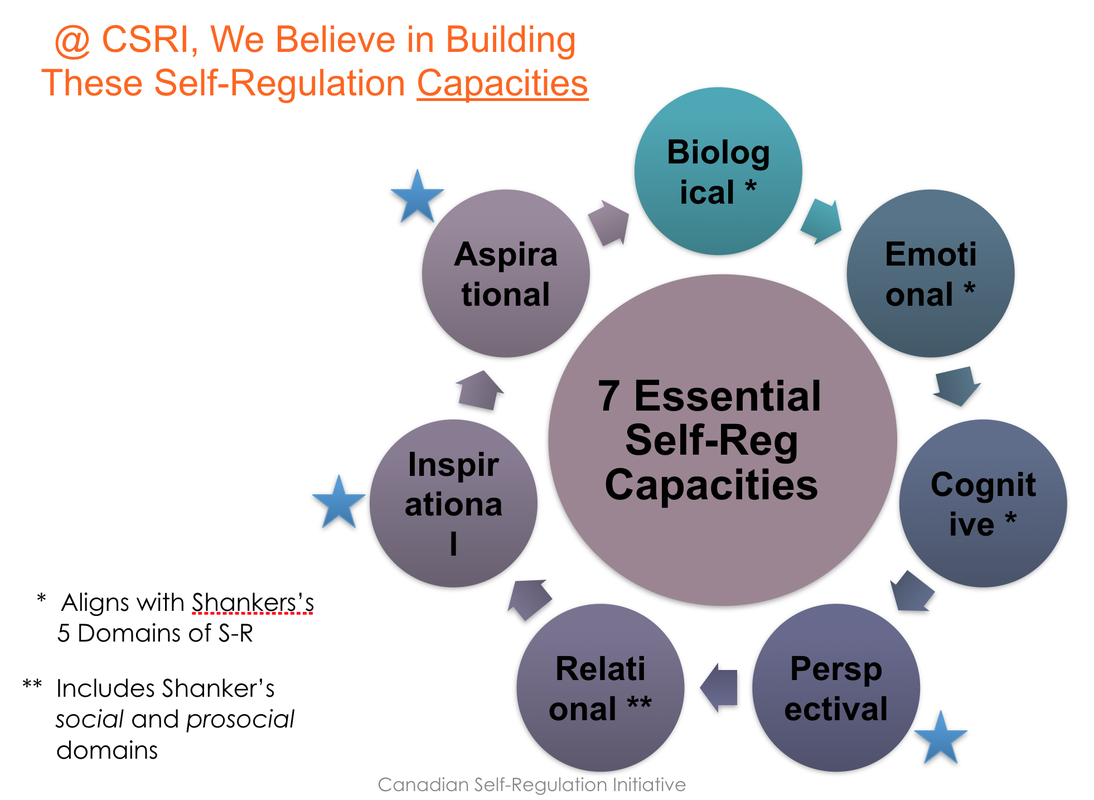 This is our new year celebration: a change of season, the end of the summer holidays and time for the school year to start – sparkling classrooms, welcoming displays, class lists, new friendships… and boundless hope that this year will be a positive learning journey. For many kids, that means going from good to great achievement; for others can be a significant breakthrough with stronger foundations being formed so that learning starts to take hold. For another group, it is an ongoing search for the rhythm that will connect them to our learning places and us to them. It’s exciting and daunting all at once to open the doors in September for one of the most important rituals and asset building commitments any society can make. It’s “back to school” season in the malls, but it’s forward to learning for our hopes and dreams. With all of that hope, we need to consider how we have shaped the learning experience to help those dreams come true. I recently presented at a session where I asked the participants to consider which of the following thinkers from the past continues to have the most profound influence on today’s schools. The three choices I provided were Frederick Winslow Taylor, B.F. Skinner and Abraham Maslow. The simple question was whose DNA is most evident in the structure, culture and operating norms of schools today? 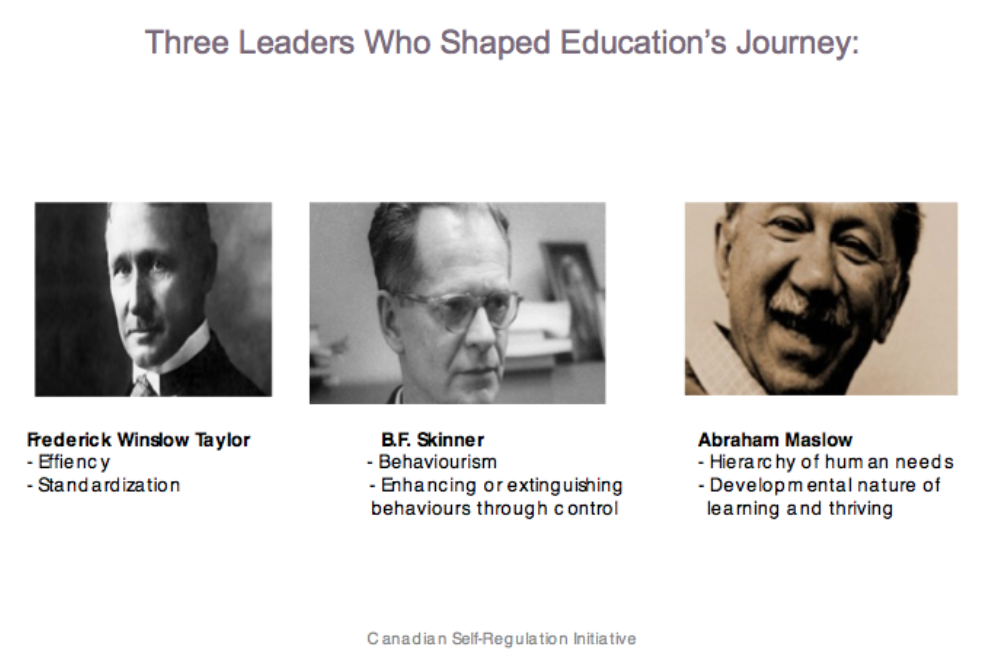 Is it Frederick Winslow Taylor, who deserves some consideration, given that we have put so much effort into achieving efficiencies and into standardization/quality control? Everything from school timetables, to curriculum & assessment, to the ringing bell summoning students and teachers to their work stations is testament to our efficiency drive. We have done a remarkable job of fine-tuning the school system to maximize standardization, to set parameters based on hours and minutes, days of instruction and bookends for learning. While there are some benefits, there are substantial problems with all of that. B.F. Skinner has also had a profound impact on schools, families, our justice system and all facets of society. Our memory of schooling and its history over 150 years is replete with hierarchical relationships based on compliance and control/reward and punishment. It was what we knew/It was what we did. A behaviourist approach – underpinned by unquestioned authority/obedience has been around for a long time, including but not limited to the schoolhouse. It has its limitations. A foundation built on exerting external controls doesn’t create the kind of environment where kids learn to thrive. But what of Maslow and his pyramid shown here, starting with a foundation of basic life needs and building from there? 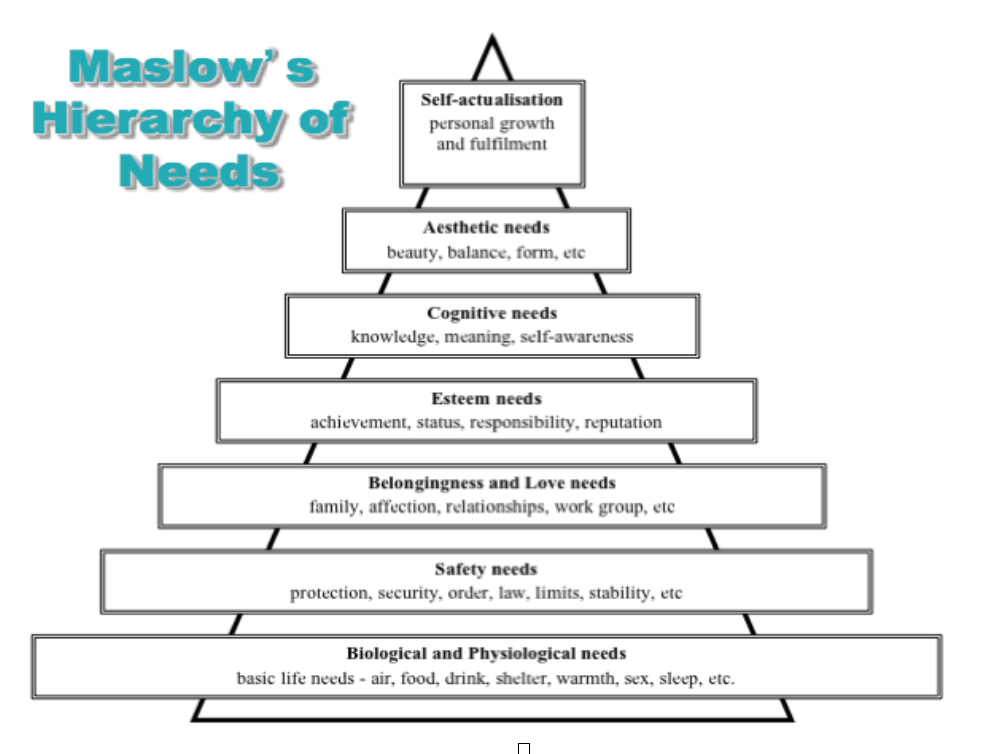 Today, we know a lot more about the intellectual, social and emotional development of the child than was ever understood by past generations. This relatively new learning is essential given how we are experiencing increased diversity in our classrooms. We also know there are students who are expected to engage and succeed at the cognitive level (at a pre-determined time – thank you Mr. Taylor) without having the necessary growth experiences and supports at the preceding steps in the hierarchy. It’s essential we don’t fool ourselves into thinking that we can create optimal learning conditions if our hightest priorities continue to be system efficiencies or to old school behaviourism?
There’s work to be done in this area. While lots of schools are well along the road to reshaping learning cultures, there are other places that are more Taylor and Skinner than Maslow. We haven’t yet managed to fully focus on what kids need rather than to perpetuate a system that was based on other priorities. It is a work in progress – meant both ways. Here’s a brief video clip to inspire that journey: http://dalailamacenter.org/educate-heart/watch-video We can also reference and borrow from the Olympic Games motto of Faster, Higher, Stronger. It isn’t a directive or a command, but a shared aspiration – a beacon to guide our path, a challenge to which we can aspire. What’s our schoolhouse version of Faster, Higher, Stronger and how do we help every learner achieve that? We might consider Maslow’s Hierarchy and particularly the high bar of self-actualization (personal growth and fulfillment) as our own version of Faster, Higher Stronger. It might be stated in a commitment like Every Child, Every Chance, Every Day, and we now have a much clearer understanding of what it takes to get there. As the opening bell rings, let’s take a look at how our schoolhouse shapes its structures, cultures and norms to meet that test. As with all important questions in education, it isn’t simple or easy – just essential. Those of us of a certain vintage grew up with “Space: The Final Frontier” opening each episode of Star Trek. We embraced Captain Kirk’s certainty that space was the final frontier. He was Commander of the Star Ship Enterprise and he was out there among the stars. Everything else had already been discovered, or so we thought: the earth’s surface and its oceans explored, mapped, named and claimed; ancient civilizations uncovered; countless mysteries solved…
But what if he was wrong? Now, more than ever, we are fascinated by another frontier – the human mind and all of its elements. Over the past decade or so, we have benefited from a golden age of neuroscience, one that provides unparalleled opportunities for educators to gain a deeper understanding of how the brain learns and how the mind works through a dynamic integration of mind, brain and relationship, combining to create physical experience, cognitive experience, emotional experience, relational experience. This emerging nexus between neuroscience and education is fertile ground for huge growth in interest in self-regulation and an uptake in schools and districts across Canada and beyond. At the Canadian Self-Regulation Initiative we support schools and systems in looking with fresh eyes on 150+ years of schoolhouse habits and rituals, many of which were based on old and insufficient understandings of how the mind and the brain function and how learning occurs. With that knowledge, we no longer believe that:
It’s both an exciting and challenging time to populate this nexus between neuroscience and education. Thankfully, there are many, many great resources to inform the journey. Here are a few that help to guide our work:
When our ancestors believed the world was flat, their reference points and expectations were based on a flat earth reality. They could rationalize whatever they saw on the horizon or in the heavens in relation to their flat earth. It all made sense given the certainties of the era. One indisputable fact led to another and reality was established. At some point, a few brave souls began to consider and speak of different possibilities, ones that caused them some trouble as they challenged the infallibility of the flat earth truth. And when their wondering took flight and their voices gained confidence, evidence became more visible and new realities emerged. Goodbye old certainties as everything changed – and no one fell off the edge.
When the 4 minute mile and the 10 second 100 yard sprint were unconquerable feats, great athletes simply couldn’t break through those standards. It wasn’t possible and many world-class runners tried and failed. The certainty that it couldn’t be done, that it was beyond human capacity, defined reality…until someone believed differently, someone ran faster and then it was done. Once the records were broken, the “impossible” barriers were conquered over and over again. Now there are high school runners achieving those standards. If a physicist from a millennium ago were asked about the possibility of traveling to the moon, the answer would have been that it couldn’t be done, never would be and such foolishness shouldn’t be spoken of again. That was absolute, based on all the available science. Eventually, new curiosities led to new theories that infiltrated old certainties and different realities began to emerge, born of a wonderful combination of curiosity and perseverance. How does any of this resonate in our educational galaxy? How many “old knowns” continue to rattle around our corridors and how many have we finally stopped believing and relegated to the archives, just like a flat earth and the unbreakable 4 minute mile? Here are a few to check on for starters: – there are smart kids and not so smart kids and “levels” of intelligence are pretty much set before we ever see kids at the schoolhouse door; – gender and ethnicity influence areas of strength: eg. boys are better at Math and Science than girls…; – the Arts are a nice frill if we can afford them but important learning happens in the core academic areas; – a school’s role is primarily to impart knowledge and content and to make judgments based on the ability to recall facts; – the 8 X 5 timetable rules supreme and learning has to be organized within that framework; – the bus schedule trumps any educational rationale for change; – the kid needs to fit the system rather than the system fitting the kid; – the reward and punishment dyad is central to motivation and the infallibility of school house rules; – discipline motivates. Misbehaving kids are just being willful, not dysregulated; – if it can’t be measured by a standard test, it can’t be very important;… …and so it goes. Your list may be different, longer or shorter. But there is a list and we work through it to create environments where new curiosities challenge old/stale certainties. Here are two thought leaders who cultivate some rich conversation as we hold current practice up to the light of what human potential can achieve:
Frederick Winslow Taylor, a standardization and efficiency guru, was a profound influence on industrial-age best practices in the late 19th and early 20th centuries. The stuff of legend, he championed the effectiveness of uniform work stations, factory whistles to regulate employee movement, and specialized/rote tasks. He deeply understood that by replicating processes in tightly controlled environments he could maximize business output/cost per unit and ensure product consistency. These were laudable goals for making tractors a hundred years ago, but not so great for school system design.
But the ghost of Taylor did cross the schoolhouse door, as was evident in countless versions of “factory model” high schools operating over the past century. Efficiency ruled, meaning that students had to fit into the pre-cast mould called schooling rather than having education wrap around the student. The 5 X 8 timetable was king and kids were (and still are to a large extent) batched by birthdate, deemed ready to start at the same moment and required to finish at the final June bell, not earlier or later. The appetite for standardization and efficiency also showed up in other ways: desk sizes in classrooms based on grade designation rather than student comfort (I remember those days), and text book titles ordered in bulk because one prescribed resource was deemed sufficient (and efficient) to meet a group’s instructional needs. There was also the matter of how the education rule book was written (contract language, board and government policy) as if there were uniformity across the system. Essentially, schools were configured, operated and furnished with the expectation that they would contain 30 similar-sized and similar-aged students all facing forward ready to “receive instruction.” With the gift of hindsight, it was an effort to impose a two-dimensional framework on a three dimensional world. Taylor would be shocked to see how far we have wandered from the mantra of uniformity, conformity and rules (see West Vancouver principal blog post link below). We aren’t all the way there yet, but many of today’s education spaces and learning/teaching rhythms are developed with a much richer understanding of the learner, her brain and the need for active engagement and individual challenge. Facing sideways or even backwards is allowed now that an appreciation of self-regulation has replaced top-down compliance and demands for self control. Open the classroom door and you will see micro-environments designed to meet students’ needs and learning preferences. Furnishings might include beanbag chairs, SWISS balls, wobble cushions and standing desks. Is that a spin bike at the back of the room? Those choices may drive the school district’s Purchasing Dept. to despair, but they are becoming part of a new normal. Take a walk down the hall to the Learning Commons, a far cry from the library stacks standing sentry to silence and isolation. See what creative teachers are doing to dissolve subject-specific silos to develop real-world interdisciplinary challenges for kids working individually and as members of teams. Check out the integration of nature into the classroom and the classroom into nature. It is all part of an inspiring and transformational journey. Unlike Taylor’s factory standardization, we understand that in our work, one size doesn’t fit all. Read Principal Judy Duncan’s post here: http://bit.ly/1lhG36Q as she reflects on some of her own “then and now.” Her school is orders of magnitude beyond a Taylor-designed factory or even its own realities of 5 or 10 years ago. Fewer rules, more guidelines; less “No” and more “Let’s see how that might work.” Pogo sticks in the playground? Probably even different sized ones. Why not. What would Taylor think? Our recent CSRI (Canadian Self-Regulation Initiative) Round Table in Vancouver connected educators and other youth service partners committed to learning more together about various approaches to self-regulation and what it takes for neuroscience to influence our system norms. Very quickly, the session went beyond the specifics of self-reg to the fundamentals needed to adopt any significant change effort. As the Transformation Agenda overtakes the status quo, we better understand what’s needed to supplant long-held beliefs about how learning takes hold. It’s a “big tent” conversation and an essential one.
Following are a few observations from our CSRI gathering :
|
 RSS Feed